Wednesday, December 8, 2021

Sturz's Classic Book to Be Reprinted?

Please notice the following.

These are the four major views we can adopt about the Byzantine text. I'd like to discuss these during the upcoming fall conference on textual criticism at Clearview Church in Henderson, NC. In conjunction with that conference, I have been working behind the scenes to have Harry Sturz's classic dissertation reprinted, and I'm happy to report that good progress is being made. Right now the book sells for $43.00 on Amazon. I am sure a reprint can be sold for far less than that. 

There are plenty of great books in the field of New Testament textual criticism, but this is one of the very best. Check back here for more on the status of the reprint. I hope to have some very good news shortly.

How to Think in a Foreign Language

Is there a turning point in language learning when you begin to think in the other language? And yes, I'm including the biblical languages of Hebrew and Greek. Here's something that might help: Walk around and say simple sentences. It may sound weird but it definitely works. Don't think of a sentence in English and then try to translate it into Greek. Just start speaking.

I did this yesterday with practically everyone who walked through my office suite. I asked them to say, for example, "I am a teacher" in Greek or Hebrew or Latin or German or whatever language I knew they had been studying. If you've had a year of any of these languages, that should come quite easily. There are two great advantages in doing this. Number 1, it forces you to think in the other language. And number 2, it exposes you to everything you don't know. 

It's important that we keep pushing ourselves to improve beyond our current level. You may think to yourself, "Yeah, I know Greek." But when you get into a situation where you actually have to use the language, then you realize that there are all sorts of gaps in your education. You want to be able to consistently train yourself to use the language in different situations. So if you are talking to me about, say, John 1:1, and you begin to tell me, "In the beginning was the Word ...," I might say to you, "Quickly, say that to me in Greek (or Latin or German or French or Hebrew)." Unless you're put into a situation where you have to talk in Greek, you're probably never going to improve your ability to think in the language. Try to transition yourself to the point where you can start thinking in the target language. 

I do remember when I arrived in Basel in 1980 to begin my doctoral studies. I found my major professor in the university library and we began to chat (in German, of course). At one point he told me he was going out for a cup of coffee. "Darf ich Ihnen begleiten?" I asked, meaning "May I accompany you?" He smiled at me and said, "Darf ich Sie begleiten?" He gently corrected my pronoun, and off we went for coffee. (I had actually been thinking in Greek while speaking German.) I spoke very little English with my professors and peers when I was in Basel. You see, my goal was to try and become proficient in German, and you can't do this if you're speaking English all the time. 

I've said a lot here, so let me summarize. It takes time to think in a foreign language because what you have to do is detach yourself from what you've been familiar with your whole life. It's quite the challenge and it takes perseverance. To make this transition you need to be trying to think in that language as much possible. I will add that thinking in your target language is much easier when you have a good handle on its grammar, so don't neglect to study that as well. Yes, it's demanding, and yes, it will expose your limitations. But that's a good thing. There's no rule as to how to do this. Experiment and see what works for you.

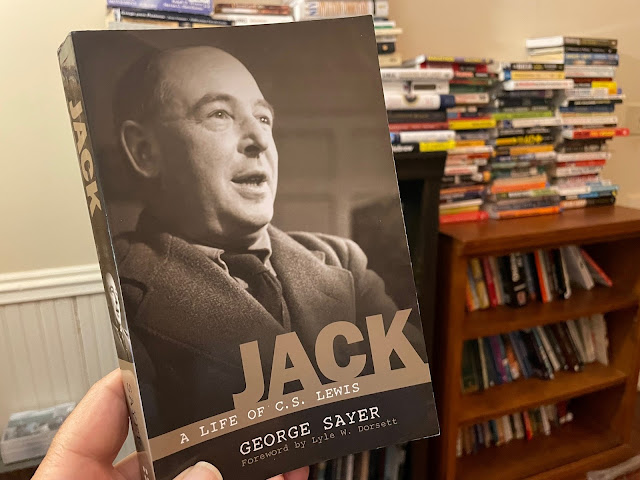
I'll close with a quote from George Sayer's biography of C. S. Lewis. 

On page 94 he writes: 

He found that he could think in Greek. 

Congratulations on your progress, and happy language learning! 

Tuesday, December 7, 2021

From Enemies to Brothers

 Oh my. The Gospel is so great. 

Can We Recover the "Original Text"?

My latest interview with Abidan Shah on the text of the New Testament is now online. 

The Beatles, and Why We Study Greek

Is music theory all that important? I thought about this question last Saturday night as I listened to the Beatles' performance (aka Fab Four). 


I found myself analyzing their work from the standpoint of a musicologist. (I began my adult life as a semi-professional trumpet player and a music major at the University of Hawaii.) I do think we can overdo this, especially when we read into a piece something that wasn't intended in the first place. But that's not why we analyze songs. Music theory is simply a set of tools that allows us to look under the hood of a song, if you will. If you want to get an idea of what makes your favorite Beatles song (or Beethoven concerto) sound the way it does, the best way to do it is to look at such matters as tonality, rhythm, the chords that are being played, etc. The Beatles consisted of four very talented musicians who really didn't understand much about formal music theory but whose products are priceless. We all speak "music." Theory is the metalanguage. If I'm able to understand, say, how an organ piece by Bach is built on a very limited number of chords, and seeing how he was able to take those handful of chords and fashion such divine beauty out of them, then I am able to better appreciate the music as music. 

Bach's Toccata and Fugue in D Minor. 

Paul and John loved the music of Bach, and in fact Bach's music inspired "Eleanor Rigby" and "For No One." I think this perfectly illustrates why it's possible to speak fluent English without ever having heard terms like subjunctive, past participle, fricative, etc. I've always admired the Beatles for coming up with some amazing music even though they didn't understand exactly what they were doing. That's why music theory has been likened to physics. It's a way of explaining something that's in a sense beyond explanation. Paul pretty much learned music through osmosis. Both of his parents were musicians. Neither of my parents were musicians but I was exposed to musical instruments from an early age. Hawaii was lush with great music. I learned to play the keyboard and ukulele long before I learned how to read notes. I heard the music in my head and found the chords to support what I was hearing. 

The crux of the matter is that we learn music theory as we go along. The terminology generally follows the appreciation. I will always be a proponent for learning music theory but I will also say that knowing theory is not required to be good at music. Music theory is like grammar. It can explain what we know intuitively. And to be able, for example, to speak intelligently about the New Testament, a knowledge of basic grammar is essential -- whether it's English grammar or Greek grammar or (preferably) both. That's one reason I'm so pleased with my students' progress in Greek this semester. They now have a foundation of language theory (verbs, nouns, adjectives, infinitives, participles, imperatives, assonance, paronomasia, etc.) that will serve them for many years to come as they begin to exegete their New Testaments. We know that "They valued his vim and vigor" sounds pleasant to the ear because the writer has used alliteration. That will have a big influence on how we detect alliteration when we see it in our Greek New Testament (Heb. 1:1 being the classic example). 

Playing music well takes remarkable talent. But when people say "I don't need to know music theory; after all, the Beatles didn't," I think they are totally wrong. The Beatles most certainly did know music theory. They just didn't learn (at first) the terms. Later, George Martin taught them that. (Martin has been called the fifth Beatle.) 

Music theory can be incredibly helpful for both composing music and performing it. Likewise, when we study Greek grammar, we are learning how to put the Greek language in its rightful place as a part -- perhaps the most technical part -- of our work in the text of the New Testament. Grammar can help us become more aware of why we understand a text the way we do when we read it, and it can help us talk about the text more precisely by providing us with a methodology through which we can show how interpretation is derived from grammatical considerations. Grammar can also help us solve problems of interpretation by showing us why one meaning is possible but not another. Above all, however, grammar can give us a point of view, a way of looking at a text that will help us develop a consistent analysis and prompt us to ask questions about the language of the text that we might have otherwise overlooked. 

Do people go to music concerts to hear theory or to hear sounds that please their ears? Of course, it's the latter. We know good music when we hear it. But when I think about the theory behind the Beatles' music, it blows my mind. Michelangelo never went to painting school before he became an artist. And yet artists have studied his paintings for ages. 

Likewise, the purpose of Greek grammar is not to make students into apologists for (or against) a given linguistic dogma. Rather, it's to make intelligent grammarians out of them -- people who are able to think about language in other than purely subjective terms and who have a vocabulary adequate to phrase the generalizations they come up with. Only if Greek leads to a curiosity about language itself, and to a sense of competence in thinking and talking about language, will it have realized the practical goals that are its ultimate justification. 

Monday, December 6, 2021

The Importance of a Comma (and Some Christmas Cheer)

 Have you seen this? 

Methinks of Paul's "I would not have you, ignorant brethren," or his "Let him who stole steal, no more let him work with his hands."

TheancientGreekswrotetheirtextswithoutanypunctuationordistinctionbetweenlowercaseandcapitals. Since then, writing has come of age. I do wish, however, that someone would publish a Greek New Testament with scriptio continuo. Would make us all slow down a bit when reading a text. 

Sunday, December 5, 2021

Organ DUET in Richmond!

Richmond looked so beautiful this afternoon. Here's the River Road Church. 

It was the venue for today's Christmas concert featuring an organ duet. (Never heard of an organ "duet"? Neither had I, until today.) 

The program featured both traditional Christmas carols as well as ancient Latin music. 

My favorite piece was "Puer Nobis Nascitur." I love Latin poetry. Music has become that way with me. Just part of my life and routine. 

Well, time to wrap this up. Gotta get ready for this week's classes. It's finals week!!!

The Fab Four in Concert

 The Fab Four performed last night at the Carolina Theater in Durham. 

Great performance! The music and mannerisms are as close to the real thing as you can get. My favorite number was George's "Here Comes the Sun." George is definitely from the Time Machine. 

Wow, just wow. 

Saturday, December 4, 2021

Pocahontas Half Marathon 2021 Report

Evening guys. This post is mostly pictures. I began the day by driving up to the Pocahontas State Park near Richmond. 

Runners were here to participate in a 5K, 10K, or half marathon. I chose the half. 

Today's race was a fundraiser for our service men and women stationed abroad. 

The race started at 9:00 sharp. 

Although it was cold, the trail was dry and easy on the feet. 

In the half, we ran the 10K course twice. 

I knew I was in trouble when about mile 6 I was passed by a lady and her dog and baby in a stroller!

Nearing the finish line. 

All in all, it was a great training run for May's marathon in Ohio. Also, it was completely beautiful. Half marathon #33 in the books. 😊 

Different subject: I'm going to hear the Fab Four tonight. I do like the Beatles music and I saw these guys a couple of years ago in Dallas. It'll be fun to see how well they perform tonight. 

The Danger of Absolute Interpretive Relativism

"Now the Lord is the Spirit, and where the Spirit of the Lord is, there is liberty" (2 Cor. 3:17). Recently I heard this verse used to justify a completely subjective reading of the Bible. The idea was, "To me, this text means .... And if the text means something else to you, that's okay. We can both be right. After all, where the Spirit of the Lord is, there is liberty." 

This is nonsense. The early church "devoted itself to the apostles' teaching" (Acts 2:42). Today, we have this apostolic word in the Scriptures, both Old and New Testaments. So I do not hesitate to say that we can't use 2 Cor. 3:17 to teach hermeneutical relativism. The Holy Spirit is "the Spirit of truth." This means that wherever the Spirit is at work, truth matters. Objective truth. It is absolutely essential for each of us to understand the importance and value of knowing the truth of God's word. 

That's exactly why I teach the historical-comparative method of Bible study. By reading the text, and by asking and answering the right questions, you can learn how to study the Bible and to discover truth for yourself. Through careful observation and interpretation you will begin to see what the text says and understand what it means. When we open the Bible, our goal is to see and understand what the original author was saying, why he said it, and how he wants us to think and act in light of it. We don't begin with our subjective experience or pre-understanding. Focusing on the text itself is an absolutely crucial step to accurately interpreting Scripture. Now, it's obvious that we have to be Spirit-filled to do this. But having the Holy Spirit to guide us into truth is no substitute for careful observation of the text itself. If we rush into application without first laying the foundation of careful observation, our understanding will be colored by our presuppositions. 

I once did a study of the theme of the book of Philippians. I concluded that the letter is all about unity in the cause of the Gospel. At the beginning of my essay, I surveyed the different books and journal articles that had been written on this topic. I concluded by writing, "All of these different interpretations obviously cannot be valid, unless one embraces absolute interpretive relativism." You and I may disagree what the theme of Philippians is. That's okay, as long as we let Scripture interpret Scripture and not read into the text the latest fad in hermeneutics. 

May God grant you a vision of what he can do in your life through your own careful study of the Bible. But you must interact with God's word personally, absorbing its message in its original context and then letting God inscribe his truth on your heart and mind. Ultimately the goal of Bible study is a transformed life and a deeper relationship with Jesus Christ. Through it we are changed from glory to glory into the image of Christ. Have at it! 

Friday, December 3, 2021

Hey Goats!

Night night! ðŸ˜‰

A Brief Tour of Maple Ridge

As you know, I just graded term papers over 3 John for my Advanced Greek Grammar class. I read each paper with great pleasure. One of them happened to be on the topic of "hospitality" (philoxenia) in 3 John. It was a fitting paper to read on the day before I had to deep clean our guest house, as I am hosting a retreat this weekend. I spent the good part of the morning going through the house and making sure all was in order. Remember, the interior is all of Becky's planning, and a wonderful job she did indeed. See if you don't agree.

Our restored 1811 farm house. We call it Maple Ridge. 

The remodeled kitchen. 

Cleaning up the dining room. The table can seat 10. 

The downstairs library is stocked with Christian books and a homeschool curriculum for long-term residents. 

The downstairs hallway. 

The formal living room. 

The upstairs landing. 

The master bedroom. 

One of two upstairs kids' rooms. 

Bec and I loved this hymn. 

I always enjoy being at Maple Ridge. In a flashback it's as though you leave the present and travel back in time. Becky's presence seems so real. I see her, hear her, sense her. Sometimes I even act as though she were still here. Do you ever do the same with someone you've lost? As you continue to remember, the pain will subside. The ache in your heart will go away. Jesus is Lord over every loss and every heartache. Does this mean you will forget? No. You will never forget. Will you be able to move on with your life? Yes. Absolutely. 

An Insight from Heb. 1:1-4?

Here's a new insight from Heb. 1:1-4 -- at least a new insight for me. In verse 3 we read, "after he had made purification for sins." The KJV and the NKJV both add "by himself" based on a variant reading here. But even if we reject the words di' heautou we can still derive the translation "by himself" (or something like it) from the middle voice of the participle poiesamenos. 


I might suggest the following rendering of the passage:

God, who spoke to our forefathers in many different times and in many different ways in the prophets, has now, at the end of the present age, spoken directly to us in a Son whom he has appointed to be the heir of all things and through whom he created the entire universe. This Son -- radiance of God's glory, exact expression of his nature, the one who holds everything together through his powerful word -- has effected in person the purification of our sins and has taken his seat at the right hand of the highest Majesty, having become as much superior to the angels as the name he has inherited is better than theirs. 

Note: "in person," not because we are following the Majority Text here, but because of the voice of poiesamenos. "By himself" would also work, of course. 

Let me know if I'm missing something. 

Thursday, December 2, 2021

On the Reading of Biographies

What books do you find most inspiring? I'd have to place biographies at the top of my list. I think most people find them inspiring too. Biographies of Christian authors are my favorites. I find them really motivating. Most of you know I don't spend time on Instagram, Twitter, Facebook, Pinterest, etc. I simply do not have enough time to devote to my farm, my teaching, my writing, my training, and my blog for all of that social media stuff. But biographies? Biographies are another story altogether. 

This book came today. 

Do ya think I'm starting it right away, as in right this very minute? Are there cows in Texas? I want to be a person who is always learning and growing. I think books help you do that. 

Maybe I'll post a review later. But for now -- let's read! 

John 3:3 -- "Again" or "From Above"?

As all of you know, I am addicted to reading. And here's an essay my assistant brought to my attention this week. 

It was a fascinating read. In it the author argues that the Greek adverb anothen in John 3:3 should be rendered "from above" rather than "again." In other words, Jesus said "You must be born from above" rather than "You must be born again." The author also argues that the translation "again" entered the English versions (not to mention French, German, Spanish, etc.) via the Latin Vulgate, where the adverb denuo ("again") was used instead of desuper ("from above"). 

He notes that the use of the adverb anothen in Koine Greek generally highlights the spatial relation rather than the temporal. This is seen in the Gospel of John itself, where anothen is used three other times and always with the meaning "from above" (John 3:31; 19:11, 23). It's interesting to me that the Nova Vulgata adopts the rendering desuper in 3:3, though not in 3:7. As for the English versions, here's what I found:

These versions use "again":

  • NIV
  • NLT
  • ESV
  • KJV
  • NKJV
  • NASB
  • CSB

These versions use "anew":

  • ERV 
  • Weymouth

And these versions use "from above":

  • ISV
  • NET
  • Young's

Most Spanish versions have de nuevo, though a couple have otra vez. As for the French, de nouveau is used except in the BDS (d'en haut = "from the top/from above"). The Luther Bible has von neuem, as do the other German versions (though I did find one example of neu). 

Reading this, I wondered why we on the ISV committee chose to render anothen as "from above." Since it's been 25 years since I produced the base translation for that version, I can't recall what discussion, if any, we had about this verse. The term itself permits either translation. Should we, then, consider both meanings to be equally valid and combine them? This is apparently what someone has done. 

Or is Jesus intentionally using a term that's ambiguous in order to draw Nicodemus into the conversation? 

So ... I'm putting it out there -- what do you think?

The Beauty of the Long Run

Ah, the long run. No endurance runner can do without it. The long run is so essential to your success in the marathon that you've got to plan it into your training schedule very carefully. Ignore it, and you will likely encounter a much more difficult marathon come race day. Pay attention to it, and your race should go much better.

My next long run is this Saturday, Lord willing. It's a half marathon trail run at the Pocahontas State Park near Richmond. Today I checked the temperature, humidity, chance of precipitation, and wind speed, and everything looks great. My plan is to run slowly and conservatively, probably with a mixture of running and walking even though 13.1 miles is a distance I can usually run without stopping. 

Half marathons are special. They shine a spotlight on your level of fitness and offer a sort of "dress rehearsal" for the marathon. Each hour, you lift your feet up and down nearly 5,000 times. The long run forces you to pace yourself so that you don't hit the wall before the end of your marathon. Any half marathon you finish feeling strong is a good one, no matter how fast or slow you run. As this is a training run, I have no time goals. I want to pay attention to the small stuff: form, cadence, nutrition, hydration, and recovery. The last 3 miles won't come easily, but you get through them because your training has made you strong enough to endure. 

For developing the aerobic engine, nothing beats the long run. Running a half marathon is a beautiful act of the will. You must let go of the urge to run too hard and too fast and accept that your strength is gradually building up to the point where you will be able to complete your target marathon. 

Truly, the long run is a beautiful thing. 

Wednesday, December 1, 2021

Ah, Simple Pleasures

 Lunch with colleagues. 

Breathtaking architecture. 


Christmas music. 


Grading papers. 

The perfect thing about a blog is that you can post anything you want, any time! 

Tuesday, November 30, 2021

Terms Papers on 3 John

Getting ready for paper presentations in Advanced Greek today. They are based on 3 John. Topics include:

  • The meaning of ekklesia.
  • 3 John 2 and the prosperity gospel.
  • The idiom "mouth to mouth."
  • Verbal aspect in 3 John.
  • The Old Testament background to 3 John.
  • The discourse structure of 3 John.

Confession: This is the best part of teaching -- watching your students present their original research. The thrill has been the journey to get there.