Tuesday, December 28, 2021

Moving from "With" to WITH

This morning in my Bible time I was bumping along in the Vulgate when I saw an interesting preposition in Gal. 1:18:

Apud is not the normal word for "with" in Latin. Then I read this verse in Luther's translation:

Again, bei is the not the usual word for "with" in German. And the Greek?

You guessed it. Pros doesn't usually come to mind when we think of "with." I immediately thought of John 1:1, where the second clause reads "and the Word was with God." Here, for the idea of "with," I might have expected "sun" or "meta" or "para." But pros is used instead.

Likewise, the Vulgate has apud and Luther has bei. In all three languages, these words seem to have a sense of personal intimacy that the other words for "with" lack. If I should say, "Ich bin bei Familie Schmidt," my use of "bei" implies that I'm not only "with" the Smith family but staying in their home, enjoying their company. Likewise, when Paul went up to Jerusalem, he stayed with Peter, undoubtedly in his very home. 

No major English translation that I know of adequately brings across this nuance of pros in John 1:1. They translate the Greek simply as "the Word was with God." C. B. Williams, however, produced his own private translation of the New Testament in 1937. It's called "The New Testament in the Language of the People." 

Here's how he renders John 1:1:

In the beginning the Word existed; and the Word was face to face with God; yea, the Word was God Himself.

I love it. It's one thing to be merely in the presence of someone. It's another thing to be enjoying close fellowship with that person. At this Christmas season, aren't you grateful for the people who've allowed you into their hearts with open arms? Do you know how to tell if someone's that intimate with you? They let you walk right into their house with a sink full of dirty dishes and their hair a mess. We all need people like that.

The Swiss are as cordial and friendly as any Americans I've ever known. They're just more, say, reserved about it. It took several months before Becky and I were invited into someone's home for supper after church when we lived in Basel. That's a really big deal over there. When speaking German, you even change the words you use to talk with one another. You are now on a familiar, even intimate, basis with that family. How sweet that is. These people are now part of your inner circle. People in your inner circle are not just any people. They visit you in the hospital and you can call them when you get a flat. 

Sometimes it's easy to forget that each of us needs a Savior -- not to mention a good old-fashioned friend to encourage us, help build us up, and even explore our pain with us. Become the friend you would like to have. It takes time to develop this kind of closeness, to move from "with" to WITH. But it goes much faster when we make the first move. 

Monday, December 27, 2021

Another Book on Linguistics?

I am a schizophrenic when it comes to the subject of linguistics. I have an overabundance of passion for the field. For instance, three of my books have the word "linguistics" in their titles. This doesn't include the journal articles I've written in which I've tried to approach a New Testament text from a linguistic point of view. I have a ridiculous number of books on the subject in my library. You get the picture.

On the other hand, I am a downright pessimist when it comes to the application of linguistics to biblical studies. We are not living in the day of A. T. Robertson, where linguistics was basically morphology and little else. You can only do so much with apophony and ablaut, with Grimm's or Verner's Laws. Some of my concerns about how we do linguistics today in evangelical circles are discussed in this interesting video. 

The speaker lists 5 pros and 5 cons of why a person should study the field of linguistics. 

PROS:

  1. You will gain a fuller understanding of language.
  2. You will learn what makes us human.
  3. You will be able to follow your own interests.
  4. You will get an access to different ways of doing science.
  5. You will not just learn about linguistics. You will learn how to do linguistics.

CONS:

  1. Studying linguistics is not a vocational training.
  2. Linguistics has internal conflicts.
  3. Linguistic terminology is a mess.
  4. Most linguistics texts are terrible to read. 
  5. Linguistics combines the worst of the humanities and the natural sciences. 

Now let's be clear. If you has asked me in the 1980s to write a book that attempted to integrate linguistics with the field of New Testament Greek, I would have told you to find someone qualified for the task. I've never taken a course in linguistics, never earned a degree in the field, never started a school of linguistics. The reason I did write such a book was that no one else more qualified than I seemed to be interested in doing that. Today, we have the opposite situation. As in textual criticism, we have an embarrassment of riches. Assessing their value, on the one side there are books on New Testament Greek linguistics that helpfully walk our students through an astonishing number of subjects they need to be familiar with. On the other side, I see a failure on the part of writers to communicate effectively with their audiences. As the speaker in the video says: 

It would be unfair of me to say that all linguists are terrible writers. What I can say is that many of the foundational texts that you'll have to read are just plain awful.

The man doesn't mince words. But he is right. This is why new introductory textbooks are needed going forward. Beginning students don't need more SBL papers. "Rabbi, I want to see." Blind Bartemaeus was asking for one of the most basic of human needs. Maybe I'm exaggerating, but my guess is that many students are pleading for basic books that smooth out the internal conflicts in the field, standardize the nomenclature, and are readable and engaging. If I'm taking my cues from many mainstream evangelical linguists, then only experts and Ph.D. students care about linguistics. What the what? I can't shake the idea that there are many beginning students out there who would appreciate learning how languages work.

Will I be writing another book on linguistics? Not on your life. I've paid my dues. So for now, I'll just kick my feet up and watch to see what happens. In 1988, when I published Linguistics for Students of New Testament Greek, I was a lot more impudent than I am today. I owned my temporary insanity and published a book that, by God's grace, is still in print 33 years later. But that can't last forever. 

Okay there. I've said it. Now who will take up the mantle? 

Sunday, December 26, 2021

Carrot Time :-)

Dallas Willard on Becoming Disciples

"The greatest issue facing the world today, with all its heartbreaking needs, is whether those who, by profession or culture, are identified as 'Christians' will become disciples -- students, apprentices, practitioners -- of Jesus Christ, steadily learning from him how to live the life of the Kingdom of the Heavens into every corner of human existence." Dallas Willard.

Here Comes the Sun

Yes, it's 71 degrees this afternoon, and yes, I'm sunbathing. 

Need my Vitamin D :-) 

Memories

I think it's funny how skewed our memories from childhood can be. I got this pic from my daughter the other day. 


As you know, she and her husband have just been stationed on Oahu. They were checking out the beach where I grew up. I know you're probably admiring the sandy shore and the islands in the background. Me? I see only the waves breaking on the horizon. 

In Kailua, the reef hardly ever broke. Most of the waves were shore break. But every once in a while the waves were so big that they would actually break a mile off shore. As soon as they hit the outer reef of Kailua Bay they provided the best waves you could possibly imagine. If I had seen this view when I was 16, it would have meant one thing: my friends and me jumping on the Hobie Cat with our boards and sailing out to the Mokulua Islands, parking the boat, and enjoying a couple of hours of perfect rides. As I said, waves like these were special. You surfed them maybe twice a year. 

Are my memories distorted? I mean, I used to think Honolulu was at least 100 miles from Kailua. When I go to Oahu today, I realize the distance is much shorter. It's really only about 10 miles, the distance I ran yesterday. One of my fondest memories of my childhood took place at this very beach. Here I am at the age of 8 in line to be baptized. 

That day, God began the hard work of changing my life. Not only is baptism a symbol, it's a prototype of discipleship. That day I had begun connecting the dots of what God wanted to do with my life, but it was only a beginning. I'm still connecting the dots today. If I didn't grasp it then, I'm getting it now: "putting Christ first" doesn't mean giving God an hour of time and a dime out of a dollar and spending the rest of my life in any way I like. Paul didn't say, "To me to live is Christ first." No, Christ is the First and the Last, the Author and the Finisher, the Beginning and the End, the Alpha and the Omega. We live "from faith to faith." 

Still, it all started that day in Hawaii when I realized I needed a Savior. And of all the things I'm thankful for right now, the connection that step of faith made between me and my heavenly Father is right there at the top of the list.

I know, I know. When you're little, things always look bigger than they really are. And I'm sure that memory fades over time. But some memories last forever.

Saturday, December 25, 2021

Today's Long Run

Marathon training rolls on, even on Christmas Day. 

For developing the aerobic engine, the long run works like magic. Today's long run transpired in Farmville, VA. 

I love to go easy, like today. I also love to go hard on race day. Right now it's time for recovery, which means a good book and a warm fire. 

Onward and upward, getting ever closer to our 2022 races! 

God's Gift for You

The wise men said, "We have seen his star in the east and have come to worship him" (Matt. 2:2).

I wonder, have you seen his star?

There are plenty of stars in the sky. We don't see them anymore, blinded as we are by city lights. We don't see the constellations and the planets and the Milky Way above us because we are so focused on our tiny, transient sparklers. 

Then there are other kinds of stars, and these we see only too easily -- movie stars, athletic stars, political stars, even religious stars -- and never have these stars been more superficial than today. They want nothing to do with the star the wise men saw. Jude calls them "wandering stars for whom the blackness of darkness is reserved" (Jude 13). Satan himself is a fallen star, a Lucifer ("Light-Bearer") fallen from heaven.

Christ, however, is the Bright and Morning Star, the Daystar, the Star out of Jacob, and he is still shining brightly in all of our darkness. When the wise men said, "We have seen his star," they weren't content to say a few nice words about it. They came to him in repentance and faith. They worshipped him and we too must bow down before him and confess him as Savior and Lord. 

Dear reader, you are so loved. Eternal life is indeed the gift of God. We are saved by simple faith that receives Jesus and confesses him as Lord. But there must be a total commitment. Worshipping the Star means giving him all we are and have. When we do this, everything changes. The wise men "went home another way." Anyone who comes to Christ goes another way from there on -- not our way but his way.

If you haven't already done so, I pray that on this Christmas Day you will come to worship Christ, and receive him as your Lord and Savior, the one who loved you and gave himself for you when he died for your sins.  

If you are already a follower of the Lord Jesus, I don't need to remind you that civilization is facing its darkest winter in a long time. The vultures have gathered for the carcass. People cry "Peace and safety" but sudden destruction still comes. May we remember that as Christians we are pilgrims and strangers. Our home is not here. The darker the days, the sooner our Lord's appearance. The night is far spent, the Day is at hand, and our redemption draws nigh. 

Much love to you all,

Dave

Friday, December 24, 2021

Forthcoming Hebrew Books

Can you read this?  

Two of my books are currently being translated into Modern Hebrew. Above is my name. I've spent the day reading through the Hebrew translation of one of them. Never thought I would see this happen. So much thanks to the translators. I do pray that these books will be an encouragement to Hebrew-speaking believers not only in Israel but wherever they live in the world. I'll let you know their titles as soon as I'm able. 

Oh My, Those Dialects!

Me: "I know German."

Me: Arrives in Basel.

Me: Weeps. 

  • "Danke" becomes "Merci."
  • "Vielen Dank" becomes "Merci vilmal."
  • "Hallo" become "Grüezi." 
  • "Tschüss" becomes "Adieu." 
  • "Guten Appetit" becomes "En Guete."

Liebe Schweiz -- Du bisch de Bescht! 

Thursday, December 23, 2021

OIDA!!!!!

Language nerds like moi love neologisms. The Coronavirus has popularized a plethora of words and phrases that we don't normally use in English. A few examples:

  • Quarantine
  • Asymptomatic
  • Social Distancing
  • Contact Tracing
  • N95
  • Zooming
  • Quarantini (a cocktail)

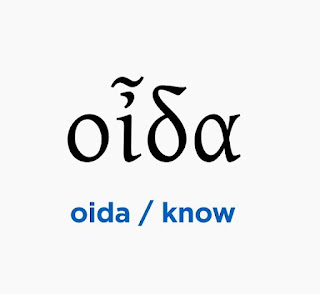
Here's a new pandemic word that's recently appeared in Austria, especially in Wien (Vienna). It's "oida." You say, "That ain't new. Even a beginning student of Greek understands that oida means 'I know.'" 

But this is a different oida. OIDA is an acronym for a series of Coronavirus-related rules that Austrians are expected to follow. 

  • "O" stands for "Obstand hoitn" (Abstand halten). English: "Keep your distance."
  • "I" stands for "Immer d'Haend' woschn" (Immer die Haende waschen). English: "Always wash your hands."
  • "D" stands for "Daham bleiben" (Zuhause bleiben). English: "Stay at home."
  • "A" stands for "A Masken aufsetzn" (Eine Maske aufsetzen). English: "Put on a mask." 

There you have it: 

Oida.

So if someone asks you, "Did you know that?", now you can say "Oida!" 

P.S. I really love studying the German that is spoken outside of Germany. It's so fascinating how the language works in other places. Als ich in Wien war, hatte ich wirklich grosse Schwierichkeiten, die Leute zu verstehen. Oesterreichisches Deutsch hat doch seinen Charme. Ich selbst finde Wien eine absolute Vorzeigstadt.

Viel Glueck im Umgang mit Corona, y'all!

Today's Cross-Training on the Bike

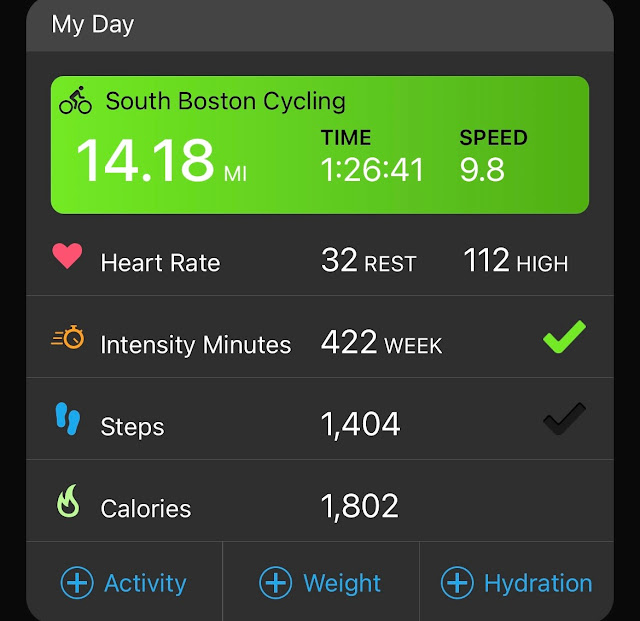
 Yesterday was a running day. Today was a bike day. 

Like you, I love getting outdoors. 

I'm only a billion marathons away from qualifying for Boston, but a man can dream, right? All I need to do is keep training, keep improving, and keep ignoring logic. O well, I failed philosophy in college.

Tomorrow is for weightlifting. Then, on Christmas Day, we are warming up to the mid-60s, which will make perfect weather for a long run. I'd like to try and get in 15 miles. 

As I often say, I'm not a gifted runner, but I am tenacious and stubborn.

A Christmas Book Giveaway

For Christmas I am giving away a copy of my beginning grammar. 

My email address is black@sebts.edu. Let me know if you would like to have this copy. All you have to do is tell me why you would like to read the New Testament in Greek. I will read all entries and then announce the giftee on Christmas day. 

Merry Christmas all!

Three Pitfalls When Learning Greek

Today I want to talk with you about what I believe are the three main pitfalls when studying Greek. They are: 

1. "I could never learn Greek."

2. "I don't need to learn grammar."

3. "Just teach me vocabulary." 

Let's examine these one by one. In the first place, I want to be absolutely clear that it doesn't take a smart student to learn Greek, just a hardworking and motivated one. My job as a teacher is much more than disseminating information. The goal is to help you overcome each and every hurdle until you have gained an ability to read your Greek New Testament with the use of a lexicon. Yes, it's going to take hard work on your part, but I'm here to help you succeed. 

In the second place, never minimize the importance of grammar. The living language/instant immersion approach has really grown in popularity in the past few years but it has its place and time, and in my opinion that's not at the beginning of your study. Of course, the living language/instant immersion approach is how you learned to speak English as a baby, but that process took years and years. You're building a grammar framework from absolute zero, and this is really tedious and time-consuming. Most of us simply don't have the time to do that. There has to be a more efficient way to learn Greek. As adults we have many advantages over a baby in how we go about learning languages, and we need to leverage those advantages whenever we can. That's why learning basic grammar is so useful. 

Finally, why can't we just learn vocabulary and forget about all this grammar stuff? To answer this question, let me give you an example from German:

Ein netter Lehrer gab seinem Student ein kleines Buch als ein Geschenk. 

A nice teacher gave his student a small book as a gift. 

One of the biggest differences between German and English is that in German there are going to be certain words that take tiny changes on the ends. I've marked these changes in our sample sentence:

Ein netter Lehrer gab seinem Student ein kleines Buch als ein Geschenk. 

These are called declensions. The fact is, you're not going to able to speak German unless you're able to make these slight changes. In other words, there is no one-to-one vocabulary swap between English and German. You can't just learn the words "nice, "his," and "small" and then string them all together. Yes, you have to put them together, but you also have to make all of these very little changes. Greek works exactly the same way. There's a whole system for this called the case system. 

So my job as a teacher is to break this whole task of learning Greek down into manageable parts. You have to start at the beginning and slowly move forward. When you take karate, you don't go from white belt to black belt overnight. You go from white belt to orange belt to blue belt to yellow belt etc. until you get to black belt. In my books and classes, principles and patterns of grammar will be uncovered gradually and systematically, and grammar will actually make sense. 

I not only love Greek, I love teaching it to others. My books on Greek are designed to demystify and simplify complex grammatical topics. I'd love to have you study with me. My beginning textbook is available at Amazon. In addition, you can watch my 24 instructional videos for free on YouTube. My goal is to help you achieve the level of proficiency you desire and have fun while you're doing it! 

Wednesday, December 22, 2021

Year in Review

Time to celebrate the goodness of the Lord. Here's my: 

Year in Review


Total number of workouts in 2021: 

301.8


Total number of miles: 

1,784.1


Total number of days: 

192


Total number of calories expended: 

1,655,000


Average weekly workouts: 

4


Average weekly distance: 

26.2 miles


Average weekly time: 

4 hours and 51 minutes  


Meister Eckhardt once said, "If the only prayer you say in your life is 'Thank you,' that would suffice." Thanks to all of you for putting up yet again with all of my boring blog posts in 2021. I value you desperately and marvel at your goodness to me. As always, love to my quirky, grace-filled family. Thank you for giving me the freedom to be me despite all of my zany hobbies. Finally, I am thankful to you, Jesus, for reminding me that I still have an oar to grab in this life. I have known you since I was 8 and have never felt alone. And now there is a new year to be greeted and a new chapter of the tale to be written, a tale that is but a prelude to an endless story of grace to unfold throughout all eternity. 

Languages Are Too Difficult to Learn

Just back from a 5 mile run. The day has turned out to be beautiful. 

Earlier in the day I had a conversation with a few locals at the Bojangles in South Boston. When I started my run I couldn't get that conversation out of my head. I had been reminded that all languages contain a variety of ways to express itself depending on gender, age, social status, standards of formality, region, etc. Most languages, including English, have a "high" literary register and a "low," more colloquial register. Virginia is blessed with a hodgepodge of styles. From west to east they are called Appalachian, Piedmont, and Tidewater. The Piedmont dialect is spoken where I live. Brits would feel right at home here. 

I love to hear Piedmont spoken. And, because I live here, I will occasionally try to speak it when I'm in a brave mood. Linguists call this style-shifting, which refers to the intentional use of different language varieties. Contrast that with code-switching -- the intentional use of two different languages. This is what happens when a local boy goes back to Hawaii and switches to Hawaiian Pidgin, or when he returns to Basel and switches from High German to Swiss German. 

One thing I've noticed about German is how different it can be depending on whether you are writing it or speaking it. In writing, you say "Er sagte," but in the spoken language you say "Ich habe gesagt." Actually, you would probably say "Ich hab gesagt." The tendency in spoken German is to "swallow the endings" -- "Ich geh," not "Ich gehe." 

One of the main differences between written and spoken German is the tendency to use the perfect more than the simple past when speaking:

Wegen des Wetters, bin ich zu Hause geblieben.

Because of the weather, I stayed at home. 

Conversely, you would write, though probably not say:

Als ich nach Hause kam ....

Ich ging in dem Supermarkt ....

Als ich mit ihm sprach ....

One final example. Did you know that German has the equivalent of our colloquial use of "like"? Normally, "like" is a preposition meaning "similar to." "Like," however, can also be used as a discourse particle, as in:

I was like, "You are NOT coming with us," and he was like, "Oh yes I am." 

In German, you use "Ich so" and "Er so," leaving out the verb "was." 

Und ich so, "Ja, das ist komisch." Und er so, "Ja, oder?"

And I was like, "Yeah, that was funny." And he was like, "Yeah, for sure." 

The one thing you don't say is:

Und ich war wie ("And I was like")! 

The moral of the story is: Languages are too difficult to learn. Just kidding. The real moral of the story is:

Life's better when we appreciate how God made languages work. And, when it includes trying to learn a language other than our own. 

Tuesday, December 21, 2021

Drummers Take Note

To any worship team drummers out there. You gotta watch this video. 

When I think of Ringo Starr, the word complement comes to mind. Ringo sensitively complemented every Beatles song that was ever recorded. He always blended into the group and never tried to draw attention to himself. I am always amazed how, in today's music, the drummer acts as if he is a soloist and the keyboardists and guitarists are there to accompany him. It is impossible to imagine how Ringo could have been any more different from that. His drumming is always appropriate. Even in the song "Rain," the drum fills genuinely fit the music. He was never flashy, just solid and musical. I have never read that anyone had to tell Ringo how to play. He just played and the rest of the Beatles were perfectly fine with it. Just listen to him drumming on "Something." Or his famous drum solo on "The End." 

Only four people in the world can be called a Beatle. Ringo is one of them, and for good reason. Many drummers today listen to themselves. Ringo listened to the band. That's why the other lads enjoyed having him in the band so much. 

Word Order in Hebrew (and Hawaiian???)

I just found this book on my shelf. 

I must have ordered it this year and then promptly forgotten all about it. It contains many fascinating chapters. The one on Hebrew word order was of special interest to me. The author waffles between saying that the unmarked word order in Hebrew is SVO (subject-verb-object) or VSO (verb-subject-object). He suggests that additional studies are needed on this subject.

On page 183, something stood out to me. The author shows how the world's languages can be categorized according to 6 (and only 6) possible orders: SOV, SVO, VSO, VOS, OVS, and OSV. The most common orders are SOV (= 45 percent of the world's languages) and SVO (= 42 percent). Then you have VSO (= 9 percent), VOS (= 3 percent), OVS (= 1 percent), and OSV (= 0 percent). 

From my reading of Latin, it seems that Latin is basically an SOV language. 

There are many exceptions, of course. The main one is the verb est. Here the verb tends to be placed between the subject and the complement. 

In Hawaiian (a language I am trying to master), the verb "to be" is always implied. Nani ka pua means "The flower is pretty" ("Pretty [is] the flower"), while Nani 'o Kalena means "Kalena is pretty" ("Pretty [is] Kalena"). "My name is David" would be Kawika ko'u inoa ("David [is] my name"). "This island is Moloka'i" would be 'O Moloka'i keia mokupuni ("Moloka'i [is] this island"). 

Moving on to action verbs, Hawaiian has four patterns:

  1. Hana 'oe = You work. (Hana = work; 'oe = you [singular].) 
  2. Ke hana nei 'oe = You are working.
  3. Ua hana 'oe = You worked.
  4. E hana ana 'oe = You will work.

We can summarize this as follows:

  1. Verb = simple action in present time.
  2. Ke Verb nei = ongoing action in present time.
  3. Ua Verb = past action.
  4. E Verb ana = future action. 

Note that hana can be a noun ("work"), a verb ("to work"), and even a place name (many of you have probably driven the dizzying Road to Hana on Maui). 

Here are a couple more examples:

  • Hana au i ka hale = I work at home ("Work I at [the] home").
  • Nana keia keiki i ke kiwi = This child watches TV ("Watches this child [at the] TV"). 
  • Kokua ke kahunapule i na keiki 'ilihune = The minister helps the poor children ("Helps the minister [to] the children poor").

Notice the na before keiki in the third sentence. To pluralize a noun in Hawaiian, you simply add the word na. The noun itself does not change its form (unlike in Greek, Latin, etc.). 

For fun, here's a brief description in 'olelo Hawai'i (the Hawaiian language) of the island where I was born and raised. Ke and ka mean "the," and 'O precedes all names. (My apologies for not being able to write the long mark [kahako] over long vowels.) 

'O O'ahu keia mokupuni. 'O Honolulu ke kulanakauhale. He melemele ka waiho'olu'u no O'ahu. He lei 'ilima kona lei. 'O Kakuhihewa ke ali'i kaulana no O'ahu. 'O Ka'ala ke kuahiwi nani.

Here's the English:

This island is O'ahu. Honolulu is the town. The color of Oahu is yellow. Its lei is the ilima lei. The famous chief of O'ahu is Kakuhihewa. The beautiful mountain is Ka'ala. 

In the map below, I've circled Mount Ka'ala. 

By the way, in Hawaiian each consonant must be followed by a vowel. Hence my name, when transliterated into Hawaiian, becomes Kawika instead of Kawik. Other than the 5 vowels, Hawaiian has only 8 consonants: H, K, L, M, N, P, W, and the okina (glottal stop). As you can see, the "D" in David becomes "K," while the "V" becomes "W" (which often has the sound of a "V" in Hawaiian!). Feel free to call me Kaveeka!

To summarize: whereas English has an SVO word order, Hawaiian has a VSO word order. In Hawaiian, you hear the subject second. This sure sounds like Greek and Hebrew to me :-)  

What Does "Teacher" Mean?

If English is based on German, Latin, and Greek, why am I called a "teacher?" Here is "teacher" in the languages I've mentioned:

  • Lehrer
  • Magister
  • Didaskalos

Why don't we use in English, say, master (derived from magister) or didact? Since I didn't know, I consulted an etymological dictionary of English. What I found surprised (and delighted) me. 

Our word teacher comes from the Old English taecan -- show, point out, demonstrate. The Proto-Indo-European root is deik -- show or point out -- as in the Greek verb deiknumi, "I show." I like that. It seems to support the notion that teaching is as much modeling as it is verbal instruction, maybe more so. 

I give Thomas Hudgins a lot of credit for reminding me that Christian education is essentially likeness education. That's because most of us learn best by example. Jesus himself said that a disciple who is fully taught will be just like his or her teacher. I want so deeply to teach like that. Luke 6:40, quite literally, changed my life. It's one reason why in college I came up with a motto: Choose a teacher, not a course. It's why I took every course Professor Nikolas Kurtanek offered even when it wasn't required. I wanted to be like him. When God sent me to Basel, he sent me to be the son of a Doktorvater. We suffer loss, I think, when we place expediency and convenience over a true education. Taking a class just to take a class is ruining us. 

Which brings me back to "teacher." A teacher is not simply a catechist, a moralizer, a pedant, an academician, an inculcator, a pedagogue. We teachers are coaches, guides, preparers, trainers, mentors, tutors. What does it communicate to my students when my office remains closed and inaccessible because I am protecting "my" time? Realizing our misplaced priorities is perhaps the ticket out of our awful educationism. Or at least it might start the engine. 

Let's do the right thing, people. 

Jesus, may there be less of me and more of you and your kingdom in my teaching this coming semester. 

Beware the Latin Perfect!

I have a completely borked relationship with Latin. There are red flags everywhere. Here's one. The Latin perfect tense does the work of two categories: the present completed and the past simple! Spock this chart:

Notice how vidi can be translated either as "I have seen" or "I saw." In narrative, I have found the "I saw" pattern to be the more common one. Here are a few examples from Mark 14-15:

exierunt = they went (not they have gone)

veniunt = they came

assumit = he took

invenit = he found

oravit = he prayed

adduxerunt = they led

audivimus = we heard

interrogavit = he interrogated

How Latin managed to survive without what in Greek is called the aorist indicative is beyond me. 

Monday, December 20, 2021

Christ, the True Center of All Worship

Today I was reading Howard Marshall's Some Considerations Concerning the Lord's Supper Today, which led me to jot down a few miscellaneous thoughts about the significance of communion. But first let me quote to you from Marshall:

In line with what appears to have been the practice of the early church the Lord's Supper should be celebrated frequently in the church, and there is good reason for doing so on each Lord's Day. 

It's time we ask ourselves why evangelical worship, for the most part, centers on the preacher. The early Christians were celebrating weekly the resurrection of Jesus Christ and feasting in anticipation of his return (Acts 20:7). Marshall says:

The Lord's Supper in the New Testament is a meal. The appropriate setting for the sacrament is a table, and the appropriate posture in our western culture is sitting. To describe the central piece of furniture as an altar is completely unjustified in terms of the New Testament understanding of the meal. 

(Some of us could replace "altar" with "pulpit.") 

My understanding of the New Testament suggests that the future of the church lies, at least partly, in the recovery of the Lord's Supper as central rather than peripheral. True worship can't be reduced to a stage, a lecture hall, or a psychiatrist's couch. Our gatherings have the word "man-centered" stamped all over them. The center of all true worship is Christ. 

(For more, see Seven Marks of a New Testament Church. Chapter 5, on the Lord's Supper, is titled "Christ-Centered Gatherings." And, in case you think I'm minimizing the importance of sound doctrine or faithful exposition of the word, see chapter 3, "Apostolic Teaching.") 

Monday Mini-Update

Greetings, friends. It got cold here yesterday, and I don't really like to run in cold weather. Pretty much all I want to do is sit by the fireplace with a good book. Once it got a bit warmer, however, I shook off my sloth and went for an easy 4 mile run at the track. Yes, it does take a bit of motivation to get outdoors on a coldish day, but the payoff? Out of this world. I feel so much better after running. It's that odd paradox about exercise: the more active you are, the more energy you have. 

Before running I warmed myself up with some Bojangles coffee while writing a few thoughts about the Lord's Supper. I may or may not publish it later on the blog. 

By the way, Bo's really does have some great coffee, and cheap too. 

Finally, here's the Lowa Alpine Expert GTX boots. 

It's designed for mountaineers who spend a lot of time in snow and alpine environments. The boots feature a midsole made of polyurethane, which is a good material for cushioning but at the same time doesn't compress. Most importantly, they are automatically crampon compatible. The only problem is that the boots are back ordered, even at the Lowa store. Just another supply chain issue. I'm told the earliest I can get a pair would be March or April. Well, I hope to be climbing in late June. I really do need this pair of boots because they are the only brand that is wide enough for my feet. Here's what I think: if the Lord wants me to celebrate my 70th birthday by climbing the Alps again, it will get done. Hands down, high altitude climbing is one of the most adventurous things I've ever done. I was kind of afraid when I got to Zermatt, but my worries disappeared when I was able to hire one of Switzerland's best alpine mountain guides who saw to it I was safe and sound during all of our climbs. Plus, he spoke Spanish and I liked that. If I am able to make it back to Zermatt next summer, this is my goal -- the summit of the 4,027 meter Allalinhorn. 

So that's all for now. I am a believer in not letting the cold (or supply chain issues) keep you from getting outdoors and being active. Come on, y'all. Get out there if you can. 

New Greek Class to Start!

In one month I will begin teaching a new introductory Greek class on Monday nights. This is one of the most important ministries God has given me in my 45 years of teaching. The goal of all Greek instruction is to establish believers in the truth of the word of God. Leaders especially need to be firmly grounded in the Scriptures and must learn how to transmit what they themselves are learning to others. We have good translations, but you never get that direct encounter with the Scriptures, that intimate knowledge, without the original languages. So I give great emphasis to mastering both Greek and Hebrew. Greek helps us in the New Testament, of course, but also in our study of the Old Testament through our reading of the Septuagint. Conversely, Hebrew helps us with the Old Testament but also enables us to read the New Testament in a Hebrew translation. One of the best tools in this regard is the new Delitzsch Gospels translation. 

I look forward to cordially welcoming each of the 27 students who have registered for the class and will make myself available to them both inside and outside of the classroom for encouragement and tutoring. The most dangerous part of social media is not its availability but what it so often distracts us from. The study of Greek takes a considerable amount of time and effort. May we, through the diligent study of God's word, become that Bride that inspires and changes the world. 

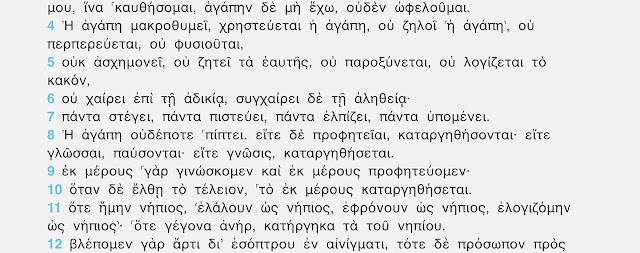
A Word about the Text of 1 Cor. 13:4

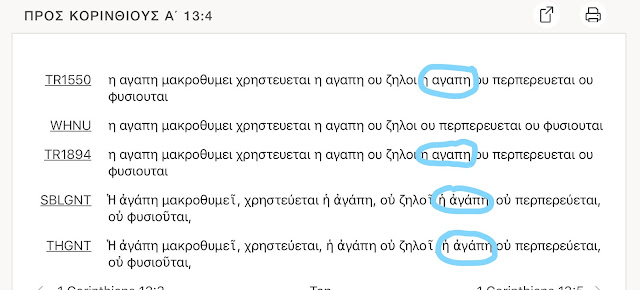
In my copy of the United Bible Society's Greek New Testament, the preface says that square brackets "in the text enclose words whose presence or position in the text is regarded as disputed ...." 

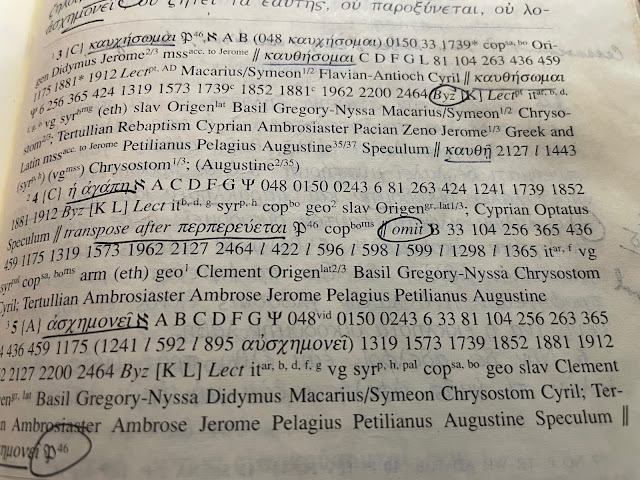
In Cor 13:4, the words he agape ("the love") occur three times. The last of these is enclosed in square brackets in my UBSGNT. Still, all editions of the Greek New Testament include the disputed words except, of course, Westcott and Hort's text. 


Now look at the apparatus in my UBSGNT: 

The omission of he agape is supported by only one Greek uncial manuscript, which is Codex Vaticanus (B), a manuscript that Hort consistently felt represented the original text in places of textual variation. One of my textual critic friends sometimes refers to the "hypnotic effect and Aleph and B." Here is a classic example. There is very little possibility that the reading of B here could be original, and, in my opinion, square brackets should never have been placed around these words. A simple footnote would have sufficed. 

I have so much to say about this but I'll save it for my my chapter on textual criticism in my book on interpreting the New Testament. 

Love Is a Verb

Public Service Announcement: There are no adjectives in 1 Cor 13:4-7 -- the verses I'm memorizing in Greek for the New Year. There are only verbs. 

Paul doesn't say "love is patient." He says something like, "love patients [verb]" or (better) "love suffers long." I was discussing this with a friend recently. "Yeah," he said, "I really need patience right now. It seems like I'm having to wait forever for ____________ to happen." In a world where we want things NOW, that makes sense. But Paul isn't talking about counting down the days until you get married or have your first baby or get your doctorate. No, this patience is exercised toward people, not things. Notice the second characteristic of love that Paul mentions here: "Love is kind acts kindly." It's a verb, remember? Obviously, Paul is packing a one-two punch. You see, we can act with longsuffering toward people without actually doing anything positive for them. But is that the best way to handle difficult, high-maintenance people? It's not enough to give grace, though that's where you have to start. No, you ask yourself, "How can I best love this person who gets on my nerves?" Here you have multiple options, but simple acts of kindness will not go unnoticed. 

Now, we need to be careful here. On the one hand, Paul is saying that love puts up with a lot. As he goes on to say, "Love doesn't demand its own way. It's not irritable or touchy. It does not hold grudges and will hardly even notice when others do it wrong" (TLB). True. But on the other hand, love "is never glad about injustice, but rejoices whenever truth wins out." So there's a fine line here. Yes, we are to prioritize keeping the peace over confrontation. But let's not enable people who demean and humiliate. Yes, long-suffering is required, but it's not grace to put up with constant bullying or neglect. Sometimes you need to walk away from certain toxic relationships because that's the loving thing to do both for you and for the other person.  

As I memorize and meditate on these verses, I am praying for perspective on this short, fleeting life of mine. Who do I need to forgive? Where do I need to release a grudge? How can I better live at peace with all? What behaviors do I need to clarify to my loved ones that I will not put up with any longer? I'm asking Jesus to send light into my heart so that I can make decisions that lead to greater health and happiness. Frankly, who could ever lead a 1 Corinthians 13 kind of life without his constant presence and power? 

Sunday, December 19, 2021

The Season for Music

Tonight was surreal. I got to listen to some of my favorite Christmas music in one of the Piedmont's most acoustical venues. 

The program featured the Choral Society of Durham, the Amalgam Brass, and David Cole on the organ. While I completely get that great classical/sacred music is not everyone's cup of tea, it was nice to see the auditorium almost packed -- and not everyone had gray hair either. 

As far as I'm concerned, Christmas is the season for joyous music. Who cares what kind of music lifts you up to God. For me, John Rutter's compositions like Gloria are beautiful, uplifting music. Love this choir! Such rich harmonies! 

Merry Christmas everyone! 

Saturday, December 18, 2021

Muffins and Cabbage!

I was in the mood to bake today so I took some muffins over to the boys' farm. 


I came back with this nice-looking cabbage. 

How do you cook your cabbage? I usually cut mine into wedges and then boil it. Add a little salt and butter and there you have it. Cabbage is the perfect food. It's loaded with vitamins and low in calories. Its fibers can also keep your digestive system working properly. 

Want to give it a shot? 

Ever Have Flashbacks?

I had a flashback this morning while working out at the Y. 

During my workout I listened to the music of Palestrina. (Speakers up, especially at the end.) 

My mind went back to the year 1970. I had just graduated from Kailua High School and had begun studying music at the University of Hawaii (Leeward Campus). That semester I was taking four classes: music theory, piano, choir, and trumpet. For the music theory class we were required to go to the library, plug in a headset, and listen to compositions from the different periods of music, including the Baroque and Renaissance eras. There I would sit for hours enraptured by the performances while gazing out the window at Naval vessels moving in and out of Pearl Harbor. 

I knew immediately there wasn't anything else like it out there in the music world. The music of Palestrina really does deserve all the praise it gets, not just for the musical and historical significance, arrangement, and performance, but also for the spirituality of the music. This is truly heavenly music to my ears. Notice that it's all Scripture -- Mary's "Magnificat" from Luke 1. (Be sure to check the video's description to read the Latin text along with an English translation.) This music was so important for the development of western music, and it stays wonderful. What a debt we owe Palestrina. What sweetness, what grace, what eloquence, what beauty of information. I'm in tears. Forgive me for saying so, but modern "church music" is mere campfire songs by comparison. It's simply a sign of our times when people can't be troubled to practice and perfect the performance of singing music like this. Modern music is the consequence of us lifting ourselves up. I'm sure there are plenty of people that prefer that. Gotta wonder, though. It's sad that most of my contemporaries don't know about this style of church music. I am fortunate to able to listen to these songs in Latin. I fall in love with the Lord again while listening. This is the true power of the human voice. 

"Who knows," wrote Will Durant, "but some not very distant age may find again in such music as Palestrina's a depth of feeling, a profound and placid flow of harmony, better fitted to express the soul of man cleansed of pride in reason and power, and standing again humble and fearful before the engulfing infinite." 

One can always hope. 

Dare Greatly But Intelligently

Now that my son has decided to run the Honolulu Marathon with me next year, I've had to tweak my race schedule for 2022. Instead of 2 marathons it looks like I'll be doing 3, in addition to the 31-mile ultra I had on the books. Here's my adjusted race schedule for 2022:

Flying Pig Marathon (Cincinnati): May 1

Night Train 50K (Farmville, VA): June 25

St. George Marathon (Utah): October 1

Honolulu Marathon: December 12

It's time to prepare mentally for the difficult challenges that lie ahead. I am beyond excited as I strive to chase down my goals and dreams for the new year, which I will do my best to share with all of you here on this blog. I started heart rate training this year so the intensity of my runs has gone way down but the endurance I built led me to a new marathon PR a month ago. My confidence is now high, perhaps dangerously high. I need to remember that it's so easy to sacrifice health on the altar of fitness and that you can't push yourself too hard. Someone has called this "adaptive excellence." No matter what your age, you continue to pursue high but not impossible standards for yourself. A realistic goal is a great motivator. Being optimistic is key. Above all, staying close to the Lord makes all the difference in the world. I think maybe the main reason I love to run is the time it gives me outdoors with the Creator of the universe. As I read his word, I see this principle time and again: Dare greatly but also intelligently. Allow him to shape your goals, and then stick with them. To everything there is a season. At 69+, any run I undertake anywhere at any time is going to be a challenge but one I look forward to each and every day. Yes, I am trying to qualify for Boston, but even if I never attain that goal (maybe when I'm 90!) I'm happy to be alive, healthy, and reasonably vigorous. Which is a beautiful thing and one for which I'm constantly thankful. 

I cannot wait to continue marathon training in 2022 as the Lord allows. I could not be more grateful for good health and the ability to move. All this will pass some day, but for now I plan to dare greatly but intelligently. 


 Sweaty but happy after running one of my first 5Ks on Aug. 15, 2015. Little did I know what that would lead to. 

Friday, December 17, 2021

My New Altra Torin 5 Road Running Shoes

While in Wake Forest today I picked up another pair of Altra Torin 5 road running shoes. 

The Torin 5 has been called the Swiss Army Knife of running shoes. Massive thumbs up! I tried them out immediately at the Neuse River Greenway. 

After 7 miles my feet and legs were still feeling very fresh. 

I know the Torin 5 is too plush for some runners, but they work for my flat feet that need lots of splaying room for my toes. I sure hope the soles hold up better this time around!