Friday, December 17, 2021

Why Two Words for "Love" in John 21:15-17?

I'm on campus today reading through John again in the Vulgate. I love studying the different "styles" of the New Testament authors, don't you? I define style as the tendency of a writer or speaker to consistently choose certain structures over others available in the language. Of course, such choice is not always conscious. Style can be intuitive or conscious. In John 21:15-17, the Vulgate obviously felt it was important to translate the Greek verbs agapao and phileo differently, even though John's style would almost require us to see these two verbs as practically synonymous. Note below how both amare and diligere are used. 

This issue has been discussed for centuries. Some acknowledge a duality here, saying that, for John, a variety of surface forms is possible. Hence the two verbs are synonymous even though they have different forms. The opposing position is that every difference in form brings with it a difference in meaning, and that true synonymy is therefore impossible. 

I don't propose to resolve this issue here. I would simply say this: The more you understand the linguistic system of Koine Greek, the more you appreciate the infinity and variety of possible choices and even combinations of choices available (not only are there two Greek words for "love" in this passage but two words for "know," two words for "sheep," and two words for "feed"). 

Is there a specialized vocabulary for John? There may very well be. Does John enjoy using synonymous words synonymously? Apparently so. The question is how consistently he does this. Only a good feel for John's style can help us here -- hence the need to read as much of John in Greek as possible. 

Kudos to the Chiefs

What has happened to coaching in the NFL? In last night's game, the Chargers kept going for it on fourth down and failing. Had they kicked field goals instead they would have won the game. I mean, it's okay to settle for just 3 points, especially early in the game. Anyhow ... a very exciting game. It was a heartbreaking loss for the Chargers, but props to the Chiefs for getting the W. 

Has anyone else noticed how competitive the season is? Lots of second and third efforts out there. Loving it. 

Thursday, December 16, 2021

Update Alert!

First of all, I had a wonderful ride today on the Virginia Capital Trail near Richmond. 


The weather was perfect for cycling. 

I got in 26.2 miles, though I had wanted to get in more miles than that. 

However, I had to cut my ride short because I had a very important luncheon today at the Addis Ethiopian Restaurant in Richmond. There I met my adopted daughter Karen and her husband Tino. Tino is an officer in the U. S. Army. 

This coming Monday they will begin their new assignment at Fort Shafter in Hawaii. They fly out Sunday, so I wanted to have one last time with them before they relocated. Tino has agreed to run the Honolulu Marathon with me in 2022, so it looks like I will "have" to go back home next year :-). That will be so much fun. Here we are finishing the Army 4-Miler in DC a couple of years ago. 

Tino is in fantastic shape and I was surprised I was able to keep up with him. (I am quite sure he slowed down for me to make that happen.) I am so glad the powers that be in the Pentagon decided to send my kids to the Paradise of the Pacific. Their three years there will change their lives completely. Today I told them that when they leave for their next duty station, they be will be saying things like okole, ono, pilikia, lanai, pupu, ohana, and pau, will desperately miss shave ice, and will be willing to sell their house for a plate lunch at Zippy's (teriyaki chicken, two scoop rice, one scoop mac salad, of course). 

Those rascals will actually be living in Ewa Beach instead of on base. It's not exactly Kailua Beach, but hey, it will do nicely. Oddly enough, my son's wife's family was also stationed at Fort Shafter back when she was 10 or so. It if this a trend, I'm all for it.  

How's that for an update?

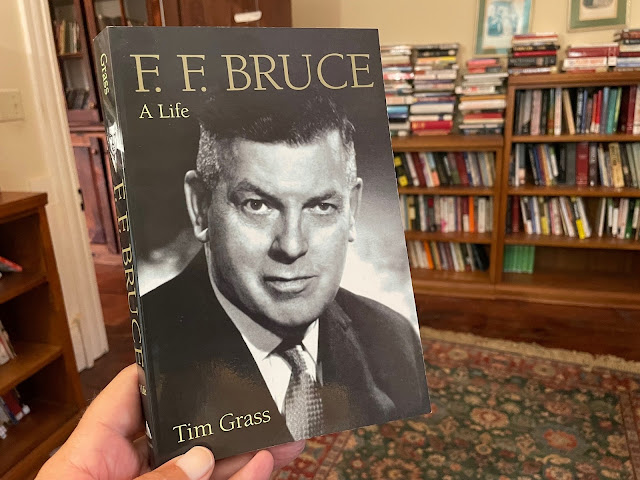
Lessons from the Life of F. F. Bruce

Sometimes we learn things in the oddest of places. The "odd" place for me last night was this biography of F. F. Bruce. 

And, since you must be totally bored to be reading this blog, I will share some of these lessons with you.

" ... no man ever did more to demonstrate how evangelical faith and total academic integrity walk hand in hand" (p. x).

"... my father [taught me] never to accept anything offered in the way of Christian faith or practice unless I saw it clearly for myself in the Scriptures. This advice I have regularly passed on to others, warning them especially not to accept anything just because I have said it" (p. 14).

"[Bruce] saw his life's work as being to mediate the fruits of higher critical study of the Scriptures to ordinary Christians" (p. 15).

"... he spoke plainly and intelligently during a service, in a way that all present could grasp" (p. 25).

" ... it was very rare for him to express any political opinion" (p. 29).

"Back in Britain during September 1935, he was surprised to receive a letter encouraging him to apply for a position as Assistant in Greek at the University of Edinburgh" (p. 29).

"Bruce's first book was to prove to be one of his most enduring: Are the New Testament Documents Reliable?" (p. 39). 

"Toward the end of his career, Bruce could assert: 'I can think of no better foundation than a classical education for the professional cultivation of biblical studies'" (p. 50).

"One was his emphasis on the need of immersion in the biblical languages and the value of a close inductive study of the primary sources which made that possible" (p. 51).

"Beyond the student world, he became a frequent lecturer on what were then known as extra-mural courses, giving a series of evening classes for the benefit of the general public" (p. 54).

"Bruce saw no tension between teaching in the university and doing so in the church" (p. 62).

"Bruce made clear that he did not see himself as one of those scholars who contented themselves with producing works of scholarship which nobody read or noticed; rather, his greatest reward was to see enthusiasm and interest being sparked in his reader as a result of his work" (p. 76).

"... he supervised around fifty doctoral students while at Manchester, said to be more than any other British supervisor in the field had ever coped with" (p. 1-6). 

"A few years before retiring, Bruce was struck by the recognition that he had attained every professional ambition which he could have expected to do ...." (p. 141).

Okay, you whipper snappers out there who are just beginning your academic career as New Testament teachers. You have in the life of F. F. Bruce a wonderful model of what that really means. 

  • For God's sake, think for yourself. Don't just spout what others are saying.
  • Never forsake the biblical languages, and encourage their use by others.
  • Speak in a way all people can understand you.
  • Refuse to drive a wedge between the academic and the devotional study of the Bible.
  • Keep quiet about your political  preferences (despite the fact that you have very strong opinions on these matters).
  • Pour your heart and soul into your students. 
  • Come to the end of your career with the satisfaction of knowing you attained your God-given goals.

It's an interesting coincidence that Bruce began teaching Greek when he was 25. (I was 24). His first book was published when he was 33. (I was 32.) Bruce retired from fulltime teaching at the age of 68. (I retired at 69). Bruce taught for a total of 43 years. (I taught for 44 years.) Apparently Bruce was just as surprised to be asked to teach Greek as I was. 

Bruce died in 1990 but his legacy lives on. And it does so, not only in his writings, but in the students he mentored through their doctoral studies. Three-fifths of them were from overseas, and a good many of them from America. If you've ever read anything by Ronald Fung, Ward Gasque, Don Hagner, Murray Harris, Morna Hooker, Seyoon Kim, Moises Silva, and David Wenham, then you have been the beneficiary, if indirectly, of Bruce's scholarship. 

I'll close with the words of the author of F. F. Bruce: A Life:

"... Bruce taught not only by his words and writings, but by his life. For that life many continue to give thanks."

Wednesday, December 15, 2021

The Unwretched Wretch

From Augustine's Confessions (1:21):

Quid enim miserius misero non miserante se ipsum. 

My text has this footnote:

English struggles to capture the fugura etymologica here (triple anaphora of miser-). 

Indeed it does! I'm tempted to render the sentence as:

For nothing is more miserable than a miser not commiserating with himself. 

Don't like it? Okay, let's try this:

For nothing is more wretched than a wretch who does not consider himself wretched. 

That any better? Methinks Augustine thought he had much in common with the apostle Paul (Rom. 7:24). 

This is way too much fun. 

The Beach Boys' Greatest Song?

I consider "God Only Knows" to be the Beach Boys' greatest song. 

It's amazing when you think that in a span of only two years Brian Wilson wrote and produced "God Only Knows," "Good Vibrations," "Wouldn't It Be Nice," and "Surf's Up." My musical soul gets so many good vibes from all of Brian's songs. But I think "God Only Knows" is the strongest of them all, both musically and lyrically. See if you don't agree. The incredible harmonies at the end are simply out of this world. This coming from a diehard Beatles fan! 

A Little Farm Cleanup (and a Big THANK YOU!)

What? Who says you can't kick off the Christmas season with a good old-fashioned work day at the farm? There is always work to be done, you know. Here were Santa's elves. Each works at the seminary. 

We kicked things off by removing all the trees and growth around the pond. 

It took tons of work but the result was beautiful, don't you think? 

Now when you go fishing you won't have to tangle with brambles and bushes. I am really excited about all the other little projects we got done today as well. 

I tell you, these guys worked their tails off. 


What I have found that is if you are going to manage a farm well, you're going to feel like you're drowning in work from time to time. I have no reservations about calling in the reinforcements when needed. So a hearty Thank You!!!! to Elijah, Josh, Alex, Zach, and Austin.

At the end of the day, when most of the things on your list get done, it is good enough and I can rest. The farm doesn't have to look perfect and you don't have to get rid of every stinking plant that looks out of place. And no matter what, there will always be more projects to do next year, next month, next week. These guys have volunteered to come back in the spring. Seems that some people will do ANYTHING for a good grade!

Musings on Ministry (and Bo Reicke)

This morning I've been reading an essay by Sverre Aalen called "Versuch einer Analyse des Diakonia-Begriffes im Neuen Testament" ("An Attempt to Analyze the Concept of Service in the New Testament"). The essay appears in a Festschrift dedicated to my former Basel professor, Swedish scholar Bo Reicke. 

I post his photo since many of you may not be able to recognize him. 

In his chapter, Aalen is interacting with a major study on the concept of service in the New Testament, one published by the honoree himself under the title Diakonie, Festfreude und Zelos, in Verbindung mit der altchristlichen Agapenfeier (Uppsala 1951). Both studies are a reminder to me that we are not only Christ people but church people too. We are not committed only to Jesus but also to his body. Everybody cannot do everything, but we can all do something of service to our fellow believers, be it the diakonia of the Word (Acts 6:4) or the diakonia of social ministry (Acts 6:2). Diakonia, which can be translated either "service" or "ministry," is, according to both Reicke and Aalen, a "Leitmotiv" in the New Testament. We are all servants and ministers for the simple reason that we are followers of one who had come not to be served but to serve (Mark 10:45). It is, therefore, inconceivable that we should spend our days in anything other than in service and ministry to others in his name. Hence it is a very grave error when we refer to the pastorate as "the" ministry. There is in the New Testament a wide diversity of gifts, callings, and ministries. 

I don't personally know the editor of this Festschrift. He studied under Dr. Reicke long before I had arrived in this lovely city on the Rhine. 

In fact, this Festschrift was published in 1984, only a year after I had graduated. But I can affirm what he says about his (and my) Doktorvater in the Editor's Preface:

Professor Bo Reicke exemplifies the scholarly excellence and Christian charity which coinhere in one who rightly claims the title of doctor theologiae.

And:

As I am sure all of his students will agree, as a teacher Professor Reicke is superb. His gifts are not so much in the lecture hall with its impersonal atmosphere as rather in those private encounters with his students in which not only the substance of scholarship but also the spirit of scholarship was taught. 

And finally:

It is not presumptuous, therefore, for me on behalf of all his students to extend to Professor Reicke heartiest best wishes and grateful thanks for his patient tutelage and steady guidance during our days of study.

I lived in Dr. Reicke's home my first month in Basel. For three wonderful years he took a personal interest in me and Becky. Even today I hold him in great respect and love. If you should be blessed to be able to do a doctorate, I hope your experience with your major professor will be as wonderful as mine was. 

Tuesday, December 14, 2021

Another Day in the Life

 Here's the sight that greeted me when I arrived back at the farmhouse this evening. 


Earlier I walked the farm in order to make a list of projects that have to be done. 

A bunch of guys from the seminary are coming over tomorrow with their weed eaters and chain saws to help me spiffy up the place. Yes indeed, I do hope that our retreat ministry will be fully operational again in 2022, hence the need I feel to have everything looking as nice as possible. 

After that, I drove to the track and got in a few miles. Still hunting down my dreams, folks. 

Unfortunately, the soles of my Altras have begun to separate from the shoes, but it's nothing a little super glue can't handle I hope. We'll see. 

Running shoes should last for at least 250 miles without these kinds of issues happening and, thankfully, they normally do. Not sure what's wrong with this pair. 

Finally, I am so glad to see that the 75 acres of pines I planted two years ago are coming up nicely. 

The spraying I did this year seemed to have really helped. 

In just over 20 years these saplings will be fully grown and ready for harvesting. So much to be grateful for. 

Just another day in the life! 

The Longest Cheese String Ever?

Stretchability is one of the most important properties of cheese. Researchers have developed a range of techniques to evaluate the stretchability of this food product. No need to thank me for this stretch profile. 

Only too happy to add my expertise to the needs of science. The fam seems to agree. 

An Excellent Tip About Language Learning

"John Locke stated that in his opinion the best way for an adult to learn Latin was by reading the Latin Bible, and so great a linguistic genius as Lord Macaulay did not disdain to learn German from the German Bible. The author feels confident from experience that those who begin with the Latin Bible and the easy Ecclesiastical authors will be able to go to the study of the Classics, if they desire to do so, with far more intelligence and profit than if they had tried to approach them without some previous preparation." 

From An Introduction to Ecclesiastical Latin by H. P. V. Nunn. 

My New Year's Resolution for 2022

During my travels in Europe, I had the odd habit of wanting to eat food simply because of its name. In Vienna I had to have a "Vienna Sausage," in Frankfurt a "Frankfurter," in Hamburg a "Hamburger," and in Paris "French Fries." Once Becky and I, on a trip to Northern Germany, drove across the border into Flensburg, Denmark just to be able to say that we had enjoyed a "Danish Pastry." Oddly enough, after we took our first bite we looked at each other in disgust and said, "This isn't a Danish! It has no sugar at all!" In the States, of course, a Danish is full of sugar. In Denmark, however, the pastry we were served was as bland as bland could be. It lacked the one ingredient we felt was necessary for anything calling itself a "pastry."

In cooking, there is often one ingredient that is absolutely indispensable. You can bake a chocolate cake, but if it lacks sugar, the result will be a complete disaster. It may look great on the outside, but when you taste it, it will be bland and awful. 

This was precisely the problem with the church at Corinth. Outwardly, the Corinthian church looked successful and spiritual. They appeared to have it all together. Paul could write of them, "You are enriched in every way. You don't lack any spiritual gift." These people seemed to have everything, but like a cake without sugar, they were a complete disaster because they had left out the one key ingredient for any church: love for one another. As a result, they were failing in the one thing that counts the most in the body of Christ.

In 2022, as God enables me, I am resolved to try and do better at this thing called love. My text will be 1 Cor. 13:4-7, which I plan to memorize in Greek, Latin, and other languages. 

Here Paul lays out the major characteristics of Christian love, both what love is and what it is not. He begins with two positive affirmations, then adds eight negative ones, and finally concludes with an additional five positive attributes -- 15 essential "ingredients" to love, as it were. To love each other has both negative and positive consequences. To love each other means that we will not judge each other or speak evil against one another. We will not envy or provoke or lie to each other. To love each other also means to be kind and compassionate to one another, forbearing and forgiving each other, encouraging one another, comforting one another, and bearing one another's burdens. 

When Paul says "love is patient" (the first ingredient of his cake), he meant that we are to be patient in respect to offenses we receive from others. As Sam Kistemaker says (1 Corinthians, p. 458), such love "demonstrates a willingness to take someone's unpleasant character traits in stride and to exhibit enduring patience." Wow. Read that again! So first of all I affirm that, to be a genuine Christian, I must exhibit patience toward all, but this is precisely what I do not do on far too many occasions. In 2022, I am asking the Spirit of God to work on me in this area of Christian living. I could go on and discuss the other 14 ingredients, but I think you get the picture. 

As a lover of languages both ancient and modern, I have to smile every time I read the opening words of 1 Corinthians 13:

If I had the gift of being able to speak in other languages without learning them, and could speak in every language there is in all of heaven and earth, but didn't love others, I would only be making noise. 

The noise we hear in evangelicalism today is deafening. Just read Twitter. (Better yet, don't read Twitter.) I think of Lewis's famous words in Mere Christianity. He is speaking of courtesy as an essential Christian virtue and part of God's "total plan for the human machine." He writes:

We have all departed from that total plan in different ways, and each of us wants to make out that his own modification of the original plan is the plan itself. You will find this again and again about anything that is really Christian: every one is attracted by bits of it and wants to pick out those bits and leave the rest. That is why do not get much further: and that is why people who are fighting for quite opposite things both say they are fighting for Christianity.

This is truly profound. "Intolerable compromise!" one person says. "Down with the heretics!" Another says, "No, we can stay in without caving in!" The tendency, on the one hand, is to pursue truth at the expense of unity, and so you separate from everyone you disagree with. But there is also a tendency to pursue unity at the expense of truth, and so you end up with syncretism. Both sides undoubtedly mean well; both are convinced that theirs is the true gospel. Perhaps, in the end, they will need to agree to disagree. But one thing we cannot do as Christians: we cannot bite and devour one another, for that is to take the sugar out of the cake. It is to deny the very gospel we are claiming to defend. If we love each other, we will "exhibit enduring patience." 

So we must learn to be patient. Neither side in an issue is perfect and always acts the right way or says the right things. God doesn't ignore these things, though we might. 

And so my 2022 New Year's resolution is to study 1 Cor. 13:4-7 with fresh eyes, trying to take off those blinders of familiarity that I tend to wear when I study a well-known passage. I want to ask myself, "What is the Lord saying to me today? Where do I need to change so that I might be more loving and less arrogant?" I do this with the hope that the Spirit of God might use this text to enable the Master Jeweler to be at work in my life, shaping, cutting, fitting, grinding, buffing, and polishing until every facet of my life reflects his beauty and holiness. Thankfully, he works delicately and -- dare I say it -- patiently.

Monday, December 13, 2021

New Review of Linguistics and New Testament Greek

Where do you go to read book reviews? Why, Themelios, of course. 

Two Latin Books

Here are two excellent books for learning Latin. 

John Collins' grammar is, in my opinion, the best introductory grammar out there. I wish I had it used to teach myself Latin instead of Wheelock. It's the perfect book to get started with. Finishing this book will give you enough grammar to begin reading your Vulgate. Each lesson builds on the previous one, and new words and concepts are introduced in small doses. As a result, you will never feel overwhelmed by your studies. Once you get the basic grammar down, then you're ready to move on to Latin texts. Tonight I'm reading Augustine's Confessions. This diglot edition has the English and the Latin texts on facing pages. I focus on reading one paragraph at a time and mastering the grammar and vocabulary before going on. For the most part, the translator did a good job of rendering the Latin, though I often find myself wishing he had a bit more literal. 

I would highly recommend both books. 

Sunday, December 12, 2021

Caroling in Richmond

This evening I attended a community-wide carol sing at a park in Richmond.


It was wonderful. 

The nearby architecture wasn't bad either. 

These buildings date back to the 19th century. 

Here's the interior of one of them. 

And here's the organ. 

So much Christmas cheer. Hope you all are doing well!

Saturday, December 11, 2021

Today's Run (and a Glance at Genesis 1-11)

It's been one week since I ran the Pocahontas Half Marathon. I suppose we all have our post-race rituals. Recovery for me has meant enjoying Mexican food, napping, reading, and recovery runs, like the 10-miler I did a couple of days ago and the 4-miler I did today. 

I hate to say it, but older runners require a longer time for recovery. If you don't give yourself adequate time for your muscles to rejuvenate, you're asking for trouble. 

While running today I listened to an interview with an evangelical scholar who, if I understood him correctly, has been espousing some sort of "myth" approach to Genesis 1-11. I have a huge amount of respect for this scholar, but I'm not happy with any approach to the opening chapters of Genesis that calls into question their historicity. No, I'm not an Old Testament scholar, but I've always read the first 11 chapters of Genesis as a straightforward, literal, and accurate historical account. I've got a few books on my shelves that cover this issue and I need to dust them off. In general, I always like to side with a plain reading of a text, and in the New Testament, I've never found any reason to jettison the historicity of the Gospels or Acts, for example. 

I won't go on and on about this. Maybe I'll give you another post in which I summarize my perspective. But right now, as I said, it's nap time. 

A Lesson from the Life of C. S. Lewis

Why is it that I am so attracted to the writings of C. S. Lewis? I mean, besides the obvious reason -- his writings are impeccable yet accessible, models of strength-in-humility, always transparent. Perhaps there are a few hints in the book I just finished reading. 

Here are a few quotes. Once you read them, I think you'll know where I'm going with all of this.

He never took for granted his gift for languages.

Jack needed only enough guidance to teach himself ....

Jack led a double life. With one faculty of his mind, he was logical and rational. With another faculty, he was as intensely romantic as a young ninetieth-century poet ....

Jack was sensitive all his life to every sort of beauty....

He knew that if he really liked a book, he would want to read it again and would find new delights in it when he did.

Jack read many books that became favorites for life.

Jack craved love and affection ....

All his life Jack took the duties and delights of friendship seriously. 

Jack tried to help his pupils get the best degrees possible ....

[H]e would walk for a few minutes ... praying, praising God, and contemplating the beauty of nature. 

He wrote ... in plain, everyday language.

As soon as he had climbed to the crest of the hill, he would stand drinking it in, with a serene, happy look, almost of ecstasy, on his face.

Do you see it? Jack was a normal human being. He was a man who had not mere knowledge of the times but an understanding of the times. Furthermore, it was a supremely practical knowledge (as we see in A Grief Observed and The Screwtape Letters). He was out to make Christ, the Son of David, Lord of all. 

After Joy died, he taught us that the only thing to do with the past is to learn whatever lessons are to be gained and then forget it. Perhaps his greatest contribution to the Christian faith was not the occasional burst of genius but the day-in and day-out testimony of Christian living in the mediocre and the monotonous. 

Always aware of cheap optimism, he was nevertheless a cheerful human being. He relished the great outdoors because there he found time to praise and worship his Creator. He was "on the go with God." Do you not sense that? Jack never thought of God as putting on a pageant for our entertainment. When God comes down from above we must rise up from beneath. 

I get the feeling that Jack was "always abounding in the work of the Lord." Even when he was puzzled and baffled by what life had thrown at him, he knew there was One alongside to help. He never seemed to forget Calvary or take the gospel for granted. His supreme goal was never survival or success or even self-satisfaction. What mattered to him was stewardship, and it is required of stewards that they be found faithful. Christ, for him, wasn't only Item Number One on the program; he was the program. 

We need a refresher course in C. S. Lewis to straighten out our warped thinking when we measure a church by quantitative rather than by qualitative standards. Reading about the life of Lewis reminded me that only we as abide in Christ can we abound for him. The only service that counts in God's eyes is the service that is the spontaneous expression of our love for Christ. As Lewis wrote in The Four Loves, all of our effort spent in religious work accounts for absolutely nothing if it is merely spent by the natural or carnal self. Only the love that is produced by Christ in our hearts is acceptable to him. 

It's been well said that God has no favorites but he does have intimates. The kind of reverent intimacy that C. L. Lewis enjoyed with his Lord seems to me to be a far cry from the coarse familiarity of the church today. Maybe there is still a lesson to be learned from his life. 

Wanna Learn Latin?

Holy eggnog, not another post about Latin! In teaching yourself Latin, one of your best resources is this one. 

Of course, right off the bat you have to make a very important decision. Shall I use the classical or the ecclesiastical pronunciation? The ecclesiastical is probably the more authentic as it is still spoken by many. Latin is most certainly not a dead language. Listening to the Bible being read in Latin is probably the best single thing you can do if you want to attain a good pronunciation of the language. Simply go to Latin Audio Bible and have at it. 

Of course, you don't have to study Latin -- unless you want to study textual criticism or want to read the early church fathers in the original language or want a leg up when you begin to study a Romance language like Spanish or want to master English grammar or are going into medicine or desire to understand Sephiroth's theme. I suppose you could even use Latin to talk to the Swiss guards at the Vatican Library. (Actually, when I was there, they preferred Swiss German.) 

I personally study Latin because I want to dabble in the Latin versions of the New Testament and the writings of the fathers, especially when the latter comment on such things as the origins of the Gospels or the authorship of certain books of the New Testament. I also think that learning Latin can help us learn English vocabulary, but then again, I'm no English teacher. I have kept up my reading of Latin for many years now. Sure, it takes a lot of practice to achieve language fluency, but if you are willing to work you can make it happen. 

When I got to Basel in 1980 I was expected to know Latin and, in fact, when I graduated with my doctorate three years later I had to swear my doctoral oath in Latin during my graduation ceremony. And, as you have probably noticed, listening to sacred music in Latin is one of my favorite hobbies. 

So much more could be said. But I hope I've whetted your appetite to at least explore the study of Latin. 

Friday, December 10, 2021

The Vocal Arts Ensemble of Durham in Concert

First Presbyterian Church of Durham played host this evening to what is perhaps the Triangle's premier vocal group. 

It's been a while since I've heard the Vocal Arts Ensemble of Durham.

The venue and musical selections were both outstanding. 

The choir's repertoire is mostly a cappella, which only makes sense when you realize that the most beautiful musical instrument God ever made is the human voice. Tonight the VAE performed traditional French and English Christmas carols, as well as German songs and one in Latin. Love this choir! Such rich harmonies! Such rich messages! So NOT Santa Claus! These carols never lose their appeal and beauty. Bravo!

O Magnum Mysterium

 This is perhaps my favorite Latin Christmas hymn of all time. 

This is the best performance of this piece because it isn't rushed. At 1:40, listen to what might just be the one of the greatest chords in all of sacred music. The base note (tonic) does not resolve and hence the dissonance. Absolute perfection. That's all I can say. 

Thursday, December 9, 2021

Greek Always

Today's 10 mile training run is now in the books. As per usual, I enjoyed the High Bridge Trail up in Farmville. 

While running, I listened to the Gospel of John in the Latin Vulgate. Sweet.

If you'll forgive yet another post about Greek and its study, an analogy occurred to me while running today. It's drawn from the sport of surfing, which I did almost daily while growing up on Oahu. If you look at this picture, you will see there are two distinct zones when a person goes surfing. 

There's the zone at the bottom of the picture, where the waves have broken, and the zone at the top, where the ocean is relatively calm and where you catch the waves. The goal of surfing is to spend as much time as you can in zone 2 trying to catch waves. But to get there, you have to pass through zone 1. When the waves are huge, as during the winter months on the North Shore of Oahu, it may take you an hour or more to get through zone 1 because of the massive amount of white water you have to paddle through. But once you're outside that zone, you have put yourself in a position to get some pretty awesome rides. 

Now, paddling in zone 1 can be incredibly difficult. The waves come crashing down on you and they constantly try to push you back to the shore. However, if you're able to push through this zone and get to the second zone, suddenly surfing becomes a lot easier and more enjoyable. You are now working with the waves instead of against them.

I believe that language learning is a very similar process. When you first start learning Greek, you're going to be in the first zone, which is usually called "beginning Greek." This is where you acquire the basic grammar of the language, and this can be very difficult. The waves are constantly trying to push you back to the shore. However, once you push past this zone and get to the second zone, where the water is much calmer, suddenly language learning becomes a lot easier and a lot more fun. Mind you, I'm not saying you're an expert when you reach the second zone. But you're able to begin building a solid superstructure on the foundation laid in your year of beginning Greek. Language learning goes from being mostly about acquiring knowledge to applying that knowledge in exegesis. And that is the reward of pushing through zone 1 to zone 2. 

What I've often seen is that many students tend to get bogged down in zone 1 for longer than they have to, and for some people forever. You feel stuck, and when you feel stuck it's very hard to motivate yourself to reap the benefits of all your efforts to push through. Sometimes it's easy to get stuck permanently and never work to apply what you pushed yourself so hard to acquire. 

So is there a "key" that will help us "push through"? Not really. But let me mention just one thing that can help. Here it is in a nutshell:

Greek always.

Notice I didn't say Greek only. I'm simply suggesting that every time you open your English New Testament to do some reading or studying, you will also open and read the same passage in Greek at least one time. I do this every single day. 

What you do after that is completely up to you. You might never go back to the Greek. Or you might choose to do a deep dive into the Greek. But you've looked at the Greek text at least once. Do this every time you open your Bible and you can't help but make progress in your mastery of New Testament Greek. 

There are, of course, many tools that can help you do this. These include both print and electronic resources. 

You can supplement your reading of the text with commentaries on the Greek text, as well as with Greek-English dictionaries. Personally, I have also found that listening to an audio file in Greek of the passage I'm studying is a great help. Resources to help you do this can be found on my Greek Portal. 

Well, I hope this brief post will help you get past zone 1 and into zone 2. If you want to get to the point where the use of Greek in your daily life is fun and instructive, all you have to do is have your Greek handy, open it up, and then read it, with helps if necessary. Try this consistently and see what happens! 

Just Multi-Slacking, Folks!

It's hard to believe, ladies and gentlemen, that the semester is over for me, as in COMPLETELY DONE. How did that happen? A shout out to everyone who made the days and weeks fly by so pleasantly for me. With additional time on my hands, life is all about writing and writing and more writing. But this morning I've been multi-slacking more than anything else. I love it, don't you, that the English language is always changing and adding words to its lexicon, like "multi-slacking." This must drive dictionary editors crazy. How in the world do you accommodate the fluidity of the English language? 

Even the Greek of the first century was a very fluid thing. I once published an essay in which I attempted to rebut an argument made by a scholar that Mark's diction was inferior to that of Matthew's and Luke's. Language is often used unwittingly as a tool for stratifying people on a social totem pole. We use "standardized" forms of English to give cachet to our professional or social goals. Likewise, we might avoid slang because people might think less of us. We have to remember that the same person can use language in different ways depending on purpose, audience, etc. The tradition is clear that Mark never set out to write a Gospel. He simply recorded the words of the apostle Peter as the latter was giving a series of talks in Rome. That's one reason why Mark reads less like a work of literature and more like a series of personal anecdotes. It is rather unintelligent, all this talk about Mark's "inferior" grammar. (See my book Why Four Gospels?) 

Does this mean that one day "should of" will replace "should have" as acceptable in a student term paper? (Yes, I see this all the time.) Is "fantabulous" a real word? I suppose we could argue that a word is "real" if one person uses it and the person he or she is communicating with understands it. Every generation has introduced new words into the English dictionary. When Paul used theopneustos in 2 Tim. 3:16, he expected to be understood, even though his readers had probably never seen the word before. 

As long as new words and new usages convey meaning, I'm for it. Don't tell me that "ain't" ain't a word where I live. (Mistaking "it's" for "its" or "their" for "they're" falls into a different category.") 

Words, as a series of letters, have no inherent meaning. Neither do the vocalizations that come out of my mouth when I am communicating with others. To go back to yesterday's blog post, I could just as easily say "Ich bin Lehrer" as "Ego sum magister" or "Ego eimi didaskalos." People simply agree upon the meaning of these vocalizations in order to communicate their thoughts to other people, thus reaching common goals most efficiently. My Swiss friend might say "I bi" instead of "Ich bin," but there is nothing wrong about his diction. Ditto for Paul saying that he was the "leaster" of all the saints in the sense that he was "less than the least" (Eph. 3:8).

I am grateful for dictionaries. I don't care what the subject or topic is, I use them all the time. The only way English will remain the same is if we stop speaking it. Which, by the way, is a good argument in favor of conversational Latin!

Tibi gratias ago. Vale!  

Wednesday, December 8, 2021

An Apology to My Greek Students

I've been spending a lot of time lately in the writings of the apostle of John. There are, of course, five of them in the New Testament. In terms of the Greek language, John's writings are undoubtedly the "simplest" form of Greek we find in the New Testament. Nevertheless, as many have pointed out, John's Greek is deceptively simple. I discussed one such example the other day -- how the adverb anothen in John 3 is apparently used by Jesus to mark a spatial rather than a temporal concept. Hence I prefer the translation "from above" over "again." Examples could easily be multiplied. I mention this because we Greek teachers often have our beginning students read the book of 1 John before they move on to other portions of the New Testament. We tell them, "John's Greek is easier than the Greek, say, of Paul." But that's a half truth at best. In other ways -- and these other ways are really, really important -- John's use of Greek is much more difficult than Paul's. 

To take an example from music, compare an alphorn to a trumpet. The alphorn looks like it would be much easier to play. 

After all, it's just a long tube. The trumpet, on the other hand, looks much more complicated. 

Yes, it has a tube, but it also has holes and valves and pistons and slides and so on. Now, you might assume you need a less intelligent musician to play the alphorn, as it has less elements to operate. However, out of my own personal experience -- I played trumpet for many years, and I once played an alphorn in the Swiss Alps -- I can tell you it's the opposite. All of those metal elements on a trumpet are there to make the life of the musician easier. It is MUCH harder to play a full chromatic scale on a "simple" alphorn than on a "complicated" trumpet. 

Hence I owe an apology to my beginning Greek students. When I told you that John's Greek is "easier" than Paul's, I wasn't telling you the truth, at least not the whole truth. Greek scholar Raymond Brown once called the prologue to the book of 1 John (1:1-4) a "grammatical obstacle course." 

The main verb doesn't occur until verse 3. What does "from the beginning" refer to? Who are the "we" John references? Why are the pronouns that refer to Christ neuter in gender? These questions, and many others, practically guarantee a Charley Horse between the ears. 

The same thing can be said about learning to speak "difficult" languages. Just what language is difficult or easy to you depends on many factors. I am convinced that French grammar is simpler than German grammar, but I've spent years studying French and am still not anywhere near fluent when it comes to speaking the language. And then there's the little matter of "gender":

  • Spanish: I'm a difficult language because I have grammatical gender. Everything is either masculine or feminine.
  • French: Think that's bad? I have grammatical gender, too, but I don't slap an "a" on the feminine nouns or an "o" on the masculine ones. So with me, you actually have to memorize the gender of nouns.
  • German: Ha! That's nothing! I have all those, plus a neuter gender, and zero logic for classifying them. Spoons are masculine! Forks are feminine! Knives are neither! 
  • Swahili: Well, I don't have gender, but I do have 8 classes of nouns. 

I like to quip to my students that I am fluent in American but I'm learning English as a second language. The truth is, with enough dedication, you can become fluent in any language you choose. I'm proud of being a native Hawaiian Pidgin speaker. And as a teacher of Greek, I can say that any language can be mastered once you have the motivation. But don't think in terms of days or weeks; think in terms of months or years.

Bonne chance!